About The Song
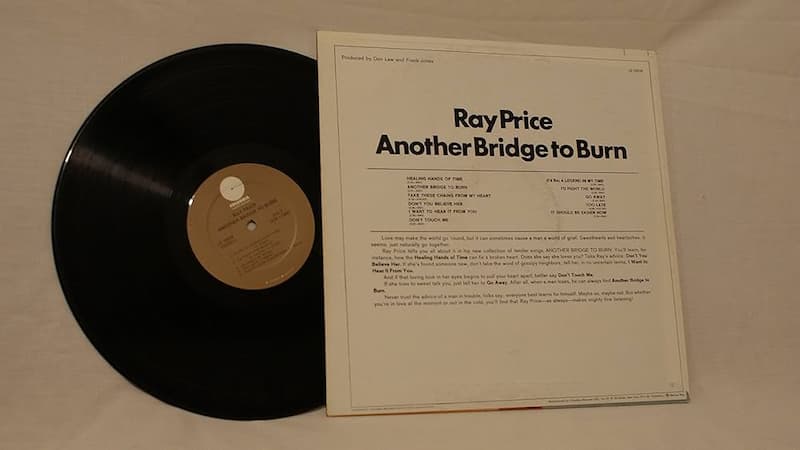
Ray Price had already established himself as a country music mainstay by the mid-1960s, known for his Texas shuffle sound and hits like “Crazy Arms.” His 1966 album *Another Bridge to Burn* captured a subtle evolution toward the smoother, string-enhanced Nashville Sound while retaining the emotional depth that defined his work. The title track, written by Harlan Howard, stood out as a highlight and gave the album its name, reflecting Price’s knack for selecting strong material from top songwriters.
Harlan Howard, one of Nashville’s most respected composers, had penned the song several years earlier. Little Jimmy Dickens recorded the first version in 1963, which reached number twenty-eight on the Billboard country chart. When Price chose it for his project, he brought a more mature perspective and his signature baritone to the lyrics. The song explores a familiar country theme: a man haunted by a pattern of failed relationships, where each romance ends in the same destructive way.
Price recorded “Another Bridge to Burn” in March 1966 at Columbia Studio in Nashville. Producers Don Law and Frank Jones oversaw the session, which featured musicians including Buddy Emmons on steel guitar, Grady Martin on guitar, and Tommy Jackson on fiddle. The arrangement balanced traditional country elements with polished touches, including subtle strings that marked Price’s growing interest in broader appeal without fully abandoning his roots.
The full album *Another Bridge to Burn* arrived in July 1966 on Columbia Records. It debuted on Billboard’s country albums chart on July 10 and climbed to the number-one position, marking Price’s second chart-topping LP. The record spent a total of twenty-four weeks on the list, demonstrating strong commercial staying power during a period when many artists were experimenting with crossover styles.
In the lyrics, the narrator admits, “I’ve had to burn most every bridge I’ve crossed,” acknowledging his role in repeated romantic failures. He had hoped the latest relationship would break the cycle, but realizes it is heading toward the same end. The chorus delivers the resigned conclusion: “Now I’m so hurt and you’re so unconcerned, and our love’s just another bridge to burn.” Price’s controlled delivery gives the words a quiet resignation rather than bitterness, letting the story unfold naturally.
The album also included three songs by a young Willie Nelson—“Healing Hands of Time,” “Go Away,” and “It Should Be Easier Now”—along with other standards like “Don’t Touch Me” by Hank Cochran. While some purists noted the shift away from raw honky-tonk, the polished production helped Price reach new listeners. The project highlighted tensions in country music at the time, as established stars balanced tradition with commercial evolution.
Decades later, “Another Bridge to Burn” remains a solid entry in Price’s catalog, illustrating his skill at interpreting songs that capture the messier sides of love and regret. It showed how one well-chosen track could anchor an entire album and keep a veteran artist at the top of the charts well into the 1960s.
Video
Lyric
I’ve had to burn most every bridge I’ve crossed
It seems like every time I’ve loved I’d lost
When I met you I thought the time would turn now you’re just another bridge to burn
I’ll soon light the match and move on I’ve already waited much too long
Now I’m so hurt and you’re so unconcerned and our love’s just another bridge to burn
Sometimes one must love enough for two and that’s how it’s been with me and you
Now I’m so hurt and you’re so unconcerned and our love’s just another bridge to burn
I’ll soon light the match…