About The Song
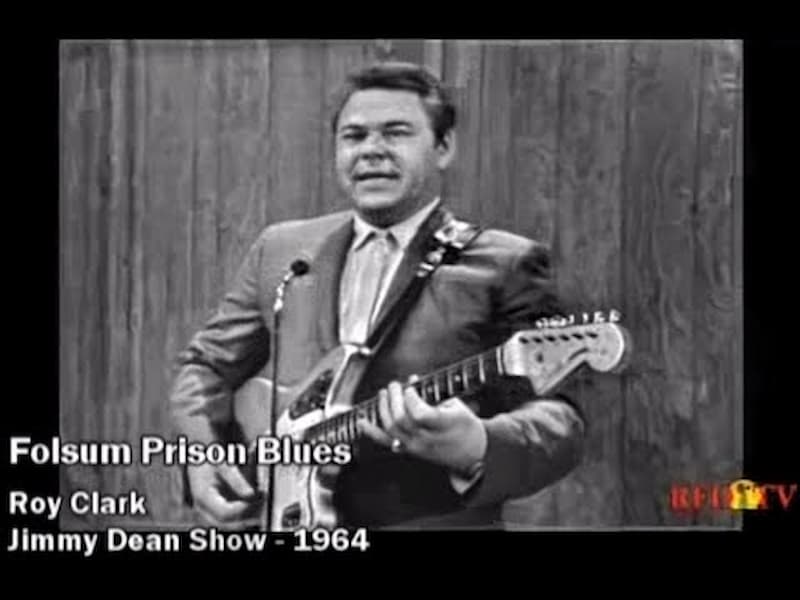
In April 1964 Roy Clark appeared on *The Jimmy Dean Show* and delivered a performance of Johnny Cash’s “Folsom Prison Blues” that instantly became a television highlight. The twenty-nine-year-old multi-instrumentalist and comedian, already gaining national attention through his guitar work and quick wit, transformed Cash’s brooding 1955 prison lament into a high-energy guitar showcase. Broadcast from Washington, D.C., the segment showcased Clark’s rapid flat-picking, intricate solos, and playful stage presence while he strummed a Fender Jaguar, turning the dark train-song narrative into an upbeat honky-tonk workout.
Clark had first heard Cash’s original on Sun Records and admired its raw storytelling. By 1964 he was signed to Capitol Records and building a reputation as one of country music’s most versatile entertainers. Rather than copy Cash’s boom-chicka-boom rhythm, Clark injected bluegrass speed and jazz-tinged runs, letting the guitar mimic the lonesome whistle and rolling wheels. The comedic touches—exaggerated facial expressions and timing pauses—fit Clark’s emerging style that would later define his long run as co-host of *Hee Haw*.
The song itself, written by Cash in 1953 after watching a documentary about prison life, tells the story of a man who shot a man in Reno “just to watch him die.” Clark kept the core lyrics intact but let his picking carry the emotional weight. Verses rolled by with crisp, lightning-fast licks between lines, while the chorus became an instrumental tour de force. Audiences who expected a straightforward cover instead witnessed a master class in country guitar that blended speed, tone, and showmanship.
The 1964 television performance circulated widely through kinescopes and later home-video releases, cementing its place in country-music lore. Clark never released the song as a charting single, but it became a staple of his live shows and appeared on early budget albums and live compilations. In 1987 he reunited with Cash for a televised duet version on *Hee Haw*, blending their contrasting styles—Clark’s flashy picking against Cash’s deeper baritone—for another memorable moment.
Over the decades Clark’s interpretation has been praised by guitarists for its technical brilliance and entertainment value. Unlike many covers that stay faithful to the original arrangement, Clark’s version highlighted his signature right-hand technique and ability to move seamlessly between country, bluegrass, and jazz. The performance helped introduce “Folsom Prison Blues” to a broader audience at a time when Cash’s prison-album renaissance was still unfolding.
More than sixty years after that *Jimmy Dean Show* appearance, Roy Clark’s take on “Folsom Prison Blues” stands as a perfect snapshot of his talent. What began as a television spot became a lasting example of how one artist could honor a classic while making it unmistakably his own. The rendition remains a favorite among fans who remember Clark not only as a singer and comedian but as one of country music’s most dazzling guitarists.
Video
Lyric
I hear that train a-commin’, it’s rollin’ around the bend
And I ain’t seen the sunshine since I don’t know when
I’m stuck in Folsom prison and time keeps draggin’ on
But that train keeps a-rollin’ on down to San Antone
When I was just a baby, my mama told me, son
Always be a good boy, don’t ever play with guns
But I shot a man in Reno, just to watch him die
When I hear that whistle blowin’, I hang my head and cryI bet there’s rich folks eatin’ in a fancy dining car
They’re probably drinking coffee and smoking big cigars
But I know I had it coming, I know I can’t be free
But those people keep a-movin’ and that’s what tortures meWell if that freed me from this prison
and that railroad train was mine
I bet I’d move it on a little farther down the line
Far from Folsom prison, that’s where I want to stay
And I’d let that lonesome whistle blow my blues away