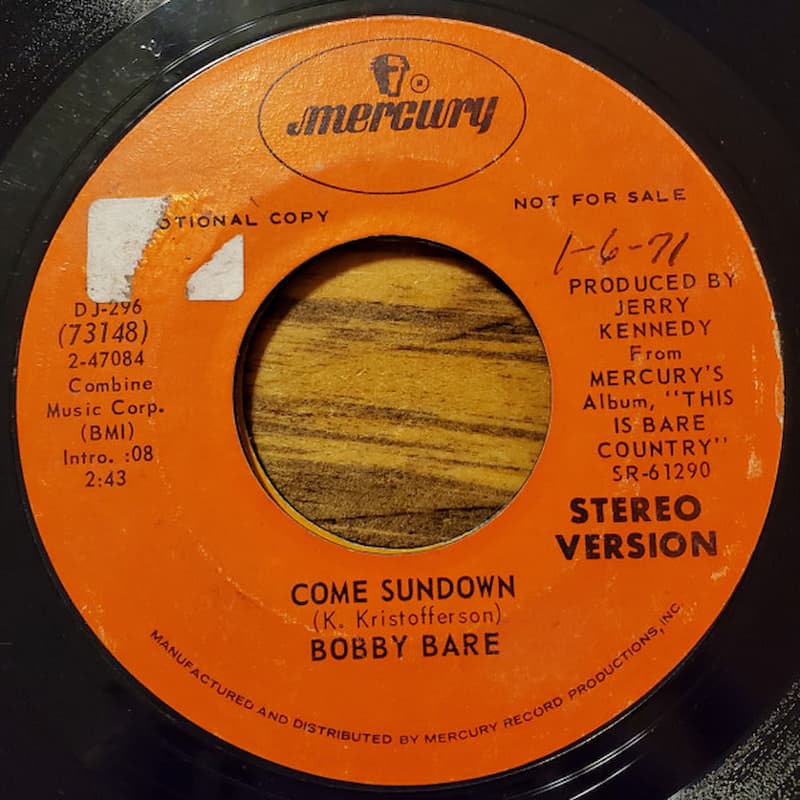
About The Song
In the fall of 1970 Bobby Bare signed with Mercury Records and quickly began recording material for his debut album on the label. Released that October under catalog SR-61290, *This Is Bare Country* featured several early Kris Kristofferson compositions. Among them was “Come Sundown (She’ll Be Gone),” a two-minute-and-forty-four-second ballad that Mercury issued as a single in late 1970. The track arrived during Bare’s successful transition to Mercury after leaving RCA, marking one of the first major country interpretations of Kristofferson’s songwriting.
Kris Kristofferson had written the song in the late 1960s while working as a janitor at Columbia Studios in Nashville. The lyrics unfold as a quiet, almost wistful promise of departure. The narrator tells his lover that he will stay until sundown, after which he will be gone, leaving her to find someone new. Kristofferson’s writing blended resignation with tenderness, creating a portrait of a man who knows the relationship has run its course yet refuses to cause unnecessary pain. Bare chose the material because it fit his relaxed, storytelling style and reflected the more introspective direction country music was taking at the start of the 1970s.
The verses describe everyday scenes—a shared cup of coffee, a final walk, the fading light of day—while the chorus repeats the gentle farewell. Bare delivered the performance with his warm, conversational baritone and understated phrasing, letting the emotional weight of the lyric settle naturally rather than pushing for drama. Mercury kept the arrangement spare and rootsy, featuring acoustic guitar, subtle steel, and soft background vocals that gave the track a late-afternoon melancholy without tipping into melodrama.
Released as a single, “Come Sundown” climbed the Billboard Hot Country Singles chart and reached number seven in early 1971. It spent several weeks on the national survey and became one of Bare’s strongest Mercury-era hits alongside “How I Got to Memphis” and “Please Don’t Tell Me How the Story Ends.” The success helped introduce Kristofferson’s songwriting to a broader country audience and confirmed Bare’s ability to turn thoughtful outside material into commercial country records.
The track fit comfortably into *This Is Bare Country*, an album that showcased Bare’s shift toward more contemporary and introspective songs after years of lighter novelty and narrative hits. Although it never crossed over to the pop charts, the single earned steady airplay on country stations and helped keep Bare’s name prominent during a transitional period in his career. It later appeared on various compilations and reissues drawn from his Mercury catalog.
Over the decades “Come Sundown” has remained a quiet favorite among fans of both Bare and Kristofferson. It has been covered by other artists, but Bare’s relaxed, empathetic version is widely regarded as one of the definitive country interpretations. The song stands as a clear snapshot of Bare in 1970, proving he could deliver Kristofferson’s poetic style with the same warmth and authority he brought to Shel Silverstein material in later years.
More than fifty years after its release, “Come Sundown” continues to resonate as a gentle meditation on endings and acceptance. What began as an early Kristofferson cover on Bare’s first Mercury album became one of the strongest singles of his early-1970s period and a lasting example of his gift for turning thoughtful lyrics into honest country music.
Video
Lyric
I heard the front door closing softly
As I wakened from my sleep
With the last touch of her lips, Lord
Like a whisper on my cheek
And I cursed the sun for rising
For the worst, Lord, is yet to come
‘Cause this morning she’s just leaving
But come sundown she’ll be gone
See the lipstick on the pillow
That I placed beneath her head
And the soft sheets still feel warm, Lord
Where she lay upon my bed
And it hurts to know it’s over
For the hurt, Lord, has just begun
‘Cause this morning she’s just leaving
But come sundown she’ll be gone