About The Song
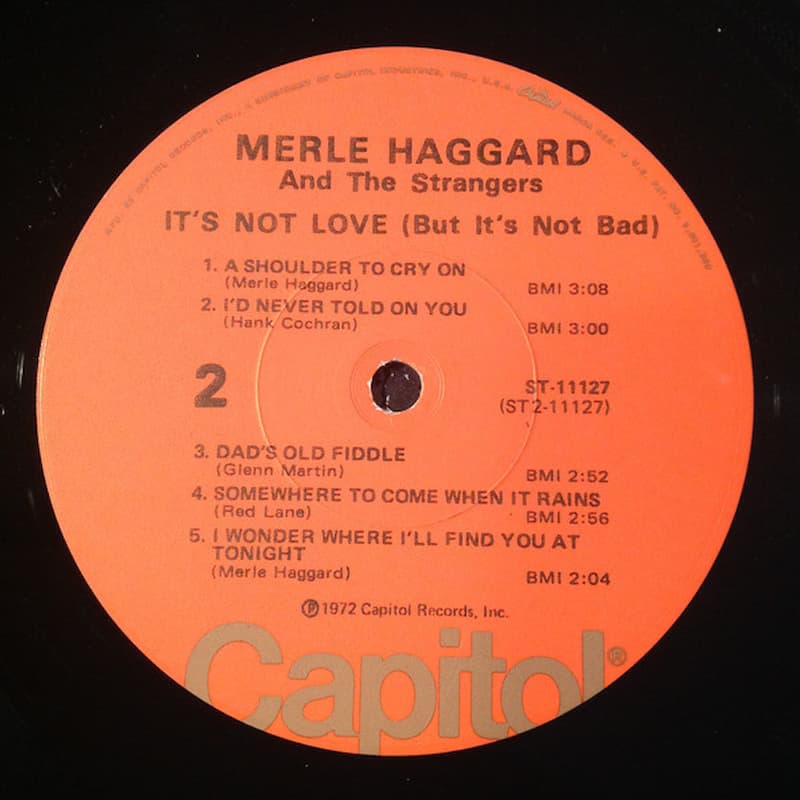
In 1972 Merle Haggard released the album *It’s Not Love (But It’s Not Bad)* and scored another number-one hit with the title track. Written by Hank Cochran and Glenn Martin, the song arrived during a remarkably productive stretch in Haggard’s career and offered listeners one of his most honest portraits of adult relationships. While it never carried the cultural weight of some of his anthems, it has remained a quiet standard for the way it captures the gray areas of love — the spaces between passion and indifference.
The lyrics describe a relationship that isn’t built on grand romance or deep emotional connection, but isn’t painful or empty either. It’s convenient, familiar, and comfortable enough to keep going. Haggard sings it without judgment or false hope, simply acknowledging that sometimes people stay together because the alternative feels worse or because the day-to-day rhythm has become its own kind of bond. His delivery is warm and unhurried, the voice of someone who understands that real life rarely offers perfect love stories.
By the early 1970s Haggard had already established himself as country music’s most consistent chronicler of working-class experience. He had delivered massive hits and cultural statements while also writing deeply personal material about prison, family, and the road. *It’s Not Love (But It’s Not Bad)* continued that thread by turning the lens on the quieter compromises people make in long relationships. The song felt like a natural evolution — less about dramatic heartbreak and more about the ordinary decisions that keep two people sharing space even when the spark has faded.
The writing story behind the track adds an interesting layer. Glenn Martin reportedly started it almost as a joke, drawing from a personal situation involving Hank Cochran at the time. Cochran took the idea seriously, refined it, and eventually placed it with Haggard. What began as a lighthearted observation became one of Haggard’s most relatable singles. The song earned a CMA nomination for Song of the Year in 1973, a testament to how deeply it resonated with audiences navigating their own imperfect relationships.
What keeps the track enduring is its refusal to romanticize or condemn. Haggard simply presents a situation many listeners recognized: two people who are not in love in the sweeping, movie sense, but who have built something that works well enough to continue. The song doesn’t promise that things will get better or worse. It simply observes that sometimes “not bad” is the honest description of where two people find themselves, and that’s enough reason to stay.
Decades later “It’s Not Love (But It’s Not Bad)” remains one of the most quietly insightful entries in Haggard’s vast catalog. It doesn’t demand attention the way some of his bigger hits do, but it rewards repeated listening with its steady compassion and its clear-eyed acceptance of how love actually works for most people — not in grand gestures, but in the small, daily choices to keep showing up even when the fireworks have long since faded.
Video
Lyric
She was always there each time I needed you
Holding on to me like I held on to you
We still don’t have what you and I once had
No, it’s not love, but it’s not bad
No, it’s not love, not like ours was
It’s not love, but it keeps love from driving me mad
And I don’t have to wonder who she’s had
No, it’s not love, but it’s not bad
I turn to her when you leave me alone
Sometimes even when you’re here, and you’re still gone
She’s slowly changing what you leave so sad
No, it’s not love, but it’s not bad
No, it’s not love, not like ours was
It’s not love but it keeps love from driving me mad
I don’t have to wonder who she’s had
No, it’s not love, but it’s not bad
No, it’s not love, not like ours was
It’s not love but it keeps love from driving me mad
And I don’t have to wonder who she’s had
No, it’s not love, but it’s not bad