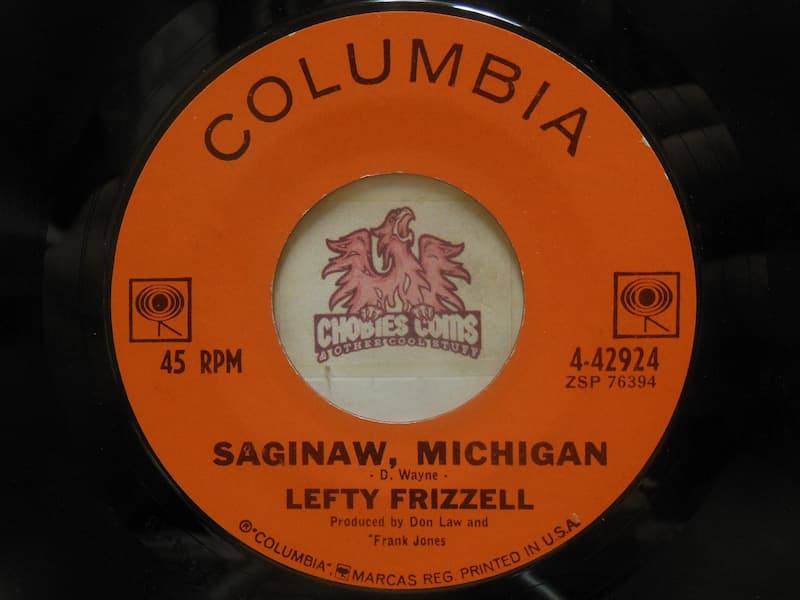
About The Song
In November 1963, country singer Lefty Frizzell released “Saginaw, Michigan,” a single that would become his sixth and final number-one hit on the Billboard country chart. Born William Orville Frizzell in 1928, the Texas-born artist had already earned a reputation as a honky-tonk pioneer with his smooth, slurred vocal style and string of early 1950s successes. By the early 1960s, however, his chart presence had cooled. The recording session on October 16, 1963, produced a three-minute-and-five-second track issued on Columbia Records with “When It Rains the Blues” on the B-side. Produced by Don Law and Frank Jones, the song appeared on Frizzell’s 1964 album of the same name and quickly found an audience drawn to its detailed storytelling.
The track was written by Don Wayne and Bill Anderson. Wayne had begun crafting the narrative but reached an impasse on how to resolve the plot. Anderson, already a successful songwriter and performer, stepped in to complete the ending. Although Anderson had considered recording the song himself, it ultimately reached Frizzell, who hesitated at first over its wordy verses. Once in the studio, however, he delivered a performance that captured every twist with natural ease, blending spoken-like phrasing and gentle slides that suited the tale’s conversational tone. The collaboration between the two writers gave the song a tight structure that felt both familiar and fresh within the evolving country sound of the era.
At its core, “Saginaw, Michigan” unfolds as the first-person account of a fisherman’s son raised on Saginaw Bay. He falls in love with the daughter of a wealthy local man who dismisses him as unworthy. Determined to prove himself, the young man heads to Alaska in search of gold. When no fortune materializes, he returns home and tells the father he has struck it rich, then sells him a worthless claim. The greedy father heads north to develop the land, leaving the couple free to marry. The final verse reveals the deception with quiet satisfaction: the “greedy fool” is still searching for gold that never existed. The real city of Saginaw, once a hub of 19th-century lumber mills along its namesake river, provided a fitting backdrop for this working-class underdog story.
Released at the tail end of 1963, the single climbed steadily. It reached the top of the Billboard Hot Country Singles chart on March 7, 1964, holding the number-one position for four consecutive weeks. It remained on the country chart for a total of 23 weeks and crossed over to peak at number 85 on the Billboard Hot 100. The song earned Frizzell a Grammy Award nomination, highlighting its appeal beyond traditional honky-tonk circles at a time when country music was absorbing elements of the folk revival.
The success of “Saginaw, Michigan” arrived after nearly four years without a major hit for Frizzell, reminding listeners of his enduring skill with narrative songs. It reflected a broader shift in country music toward longer, story-driven records that emphasized character and plot over simple heartbreak. Over the decades the track has been recorded by artists including Johnny Cash, George Jones, Bobby Bare, and later Randy Travis, each version underscoring its lasting charm. Frizzell himself continued performing until his death in 1975 at age 47, leaving behind a catalog that influenced generations of country singers.
Even today the song keeps Saginaw, Michigan, alive in popular memory. Residents of the actual city have noted how the record put their hometown on the national map, turning a place known for its industrial past into the setting of a clever romantic fable. With its blend of humor, deception, and down-to-earth resolve, “Saginaw, Michigan” stands as both a career bookend for Lefty Frizzell and a classic example of country music’s storytelling tradition.
Video
Lyric
I was born in Saginaw, Michigan
I grew up in a house on Saginaw bay
My dad was a poor, hard working Saginaw fisherman
Too many times he came home with too little payI loved a girl (I loved a girl) in Saginaw, Michigan (Saginaw, Michigan)
The daughter of a wealthy, wealthy man
But he called me “That son of a Saginaw fisherman”
And not good enough to claim his daughter’s handNow I’m up here in Alaska, looking around for gold
Like a crazy fool, I’m digging in this frozen ground so cold
But with each new day, I pray I’ll strike it rich and then
I’ll go back home and claim my love in Saginaw, MichiganI wrote my love (I wrote my love) in Saginaw, Michigan (Saginaw, Michigan)
I said, “Honey, I’m coming home, please wait for me
And you can tell your dad, I’m coming back a richer man
I hit the biggest strike in Klondike history”Her dad met me (Her dad met me) in Saginaw, Michigan (Saginaw, Michigan)
He gave me a great big party with champagne
Then he said, “Son, you’re a wise young ambitious man
Will you sell your father-in-law your Klondike claim?”