About The Song
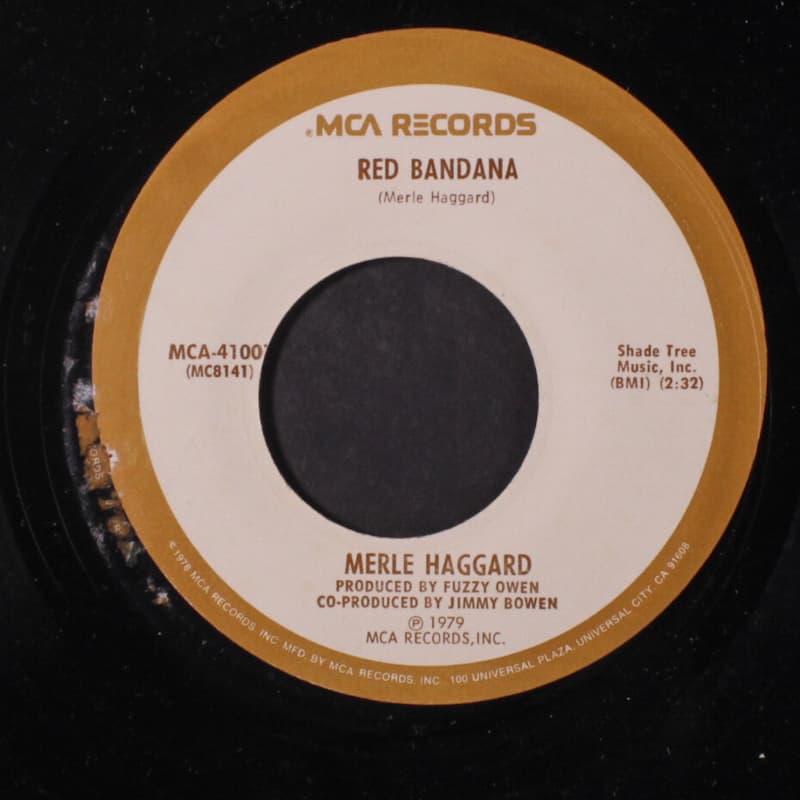
In March 1979 Merle Haggard released “Red Bandana” as the first single from his album *Serving 190 Proof*. Written entirely by Haggard, the song reached number four on the Billboard Hot Country Singles chart and offered listeners a characteristically honest look at the tension between restlessness and connection. While it never became one of his biggest anthems, the track has endured as a clear-eyed portrait of a man who knows his own limitations yet still notices what he’s missing.
The lyrics describe a narrator who admits he can’t grow up and settle down the way some people expect. He’s built for movement, for the road, for the freedom that comes with not putting down roots. Yet he can’t help appreciating the simple beauty of a woman who wears a red bandana in her hair — someone grounded, unpretentious, and steady in ways he knows he isn’t. Haggard delivers the words with his usual warmth and restraint, turning what could have been a standard honky-tonk tale into something more reflective about the choices people make and the people they notice along the way.
By the late 1970s Haggard was deep into a phase of more personal and introspective songwriting. Albums like *Serving 190 Proof* and the ones that followed explored middle age, relationships, and the costs of the life he had lived. The title of the album itself — a reference to strong, undiluted liquor — signaled the raw, no-frills honesty he was aiming for. “Red Bandana” fit naturally into that body of work: a song about a man who recognizes his own restlessness without romanticizing it or pretending it doesn’t come at a price.
What gives the track its lasting appeal is how little it tries to resolve the tension at its center. Haggard doesn’t suggest the narrator will suddenly change or that the woman with the red bandana will wait around. He simply observes the attraction between two different kinds of people — one built for wandering, the other carrying a quiet steadiness — and lets the listener sit with the bittersweet reality that some connections are felt more than they are acted upon.
The song also reflects Haggard’s ongoing interest in the lives of ordinary working people and the small details that define them. A red bandana isn’t a grand romantic gesture; it’s an everyday item that becomes meaningful because of who wears it and how she carries herself. That attention to the ordinary was one of Haggard’s greatest strengths as a songwriter, and it’s on full display here.
Decades later “Red Bandana” remains a quietly resonant entry in Haggard’s vast catalog. It doesn’t demand attention the way some of his rowdier hits do, but it rewards repeated listening with its honest exploration of restlessness, attraction, and the compromises people make — or refuse to make — in love and in life. In a career built on telling the truth about working-class experience, this track stands as a gentle reminder that sometimes the most telling stories are the ones about the things we notice but don’t quite reach for.
Video
Lyric
We left home when we’re barely past eleven-teen
We’ve been back and forth and all around through hell and rain
I’ve loved you half of your life, and I’ll keep on loving you
But I can’t change and live the way you want me to
We spent a lot of time out on the highway
Coming from some town, we played along the way
After 30 years and knowing me the way you do
You know I can’t change and live the way you want me to
But babe, that red bandana tied around your auburn hair
You look like you ought to be somebody’s wife somewhere
You ain’t never going to be no Bobby McGee, but you’re trying to
But I can’t change and live the way you want me to
Every time you leave the stage, I know you’ve had your fill
And I wonder why you grew up and why I never will
Hey, I’m 41 today, still going on 22
But I can’t change and live the way you want me to
That red bandana tied around your auburn hair
You look like you ought to be somebody’s wife somewhere
You ain’t never going to be no Bobby McGee, but you’re trying to
Yeah, but I can’t change and live the way you want me to
No, I can’t change and live the way you want me to